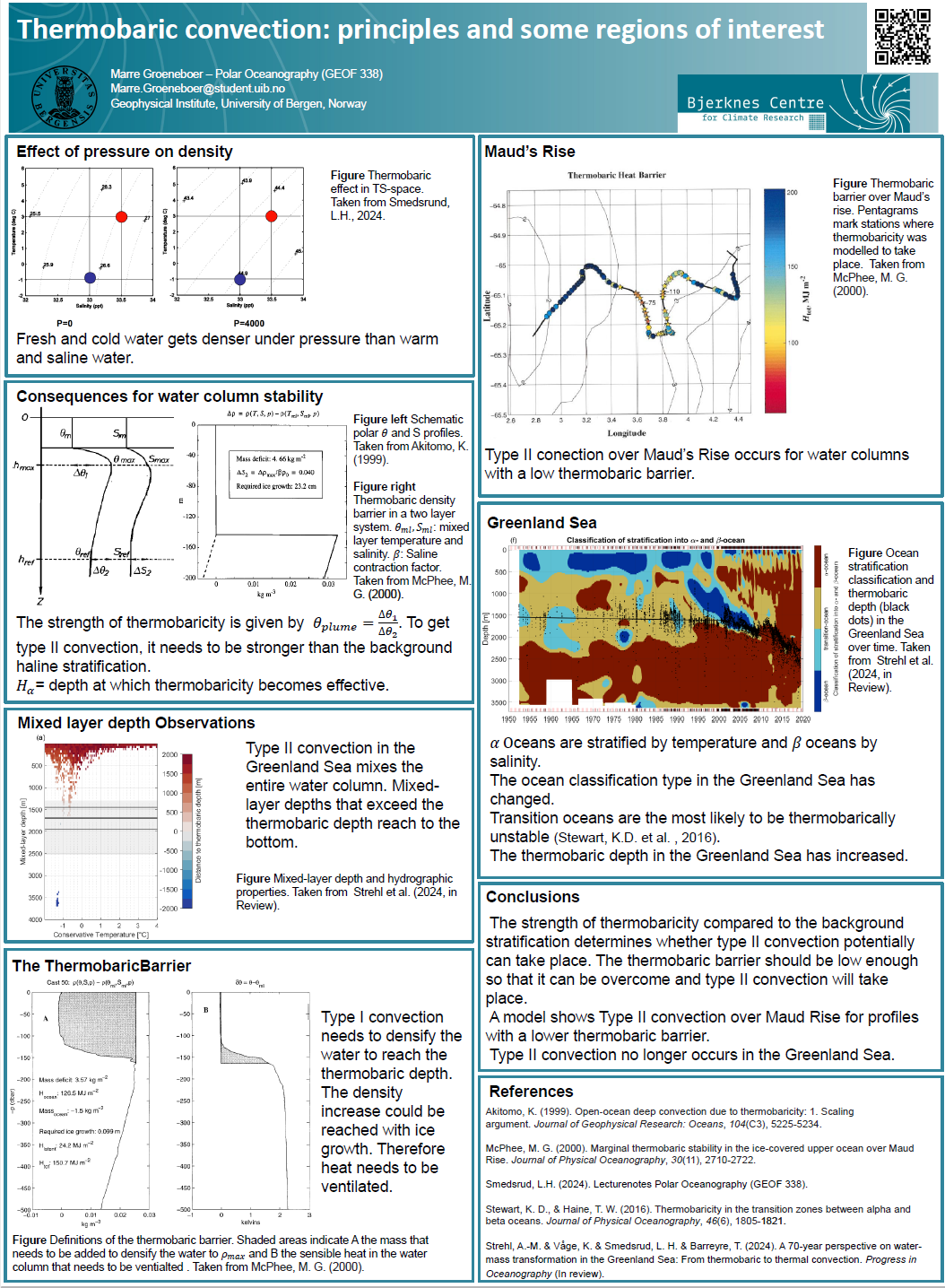
Thermobaric convection: principles and some regions of interest

Abstract

The density of water depends on temperature, salinity and pressure. When sea ice forms brine rejection takes place which leads to an increase in the density of the underlying water. Depending on the ocean stratification, this can lead to convection where the denser water sinks. This type of convection is called type I convection and occurs regularly during winter in polar seas. It slowly deepens the mixed layer as the pycnocline gets eroded. However, there is also a type II convection that can only take place under specific circumstances, and which can lead to ventilation of the entire water column. This type of convection relies on thermobaricity: the effect of pressure on water’s density. Colder, fresh waters get more compressed (and thus dense) under pressure than warm, saline waters. This means that a seemingly stable ocean profile might be unstable when a water parcel reaches a depth where thermobaricity becomes important. This can then result in type II convection. However, in order to get a type II convection, the background stratification needs to be overcome. The normalised strength of thermobaricity indicates the likeliness of this to happen. Still, there is another important factor that determines whether type II convection can occur: the thermobaric barrier. This poster dives into the processes controlling thermobaricity and examines a case study over Maud Rise near Antarctica. Lastly, it provides an overview of stratification types in the World oceans.
Poster number:

338_3

Authors:

Marre Groeneboer

GEOF338 - Spring 2024

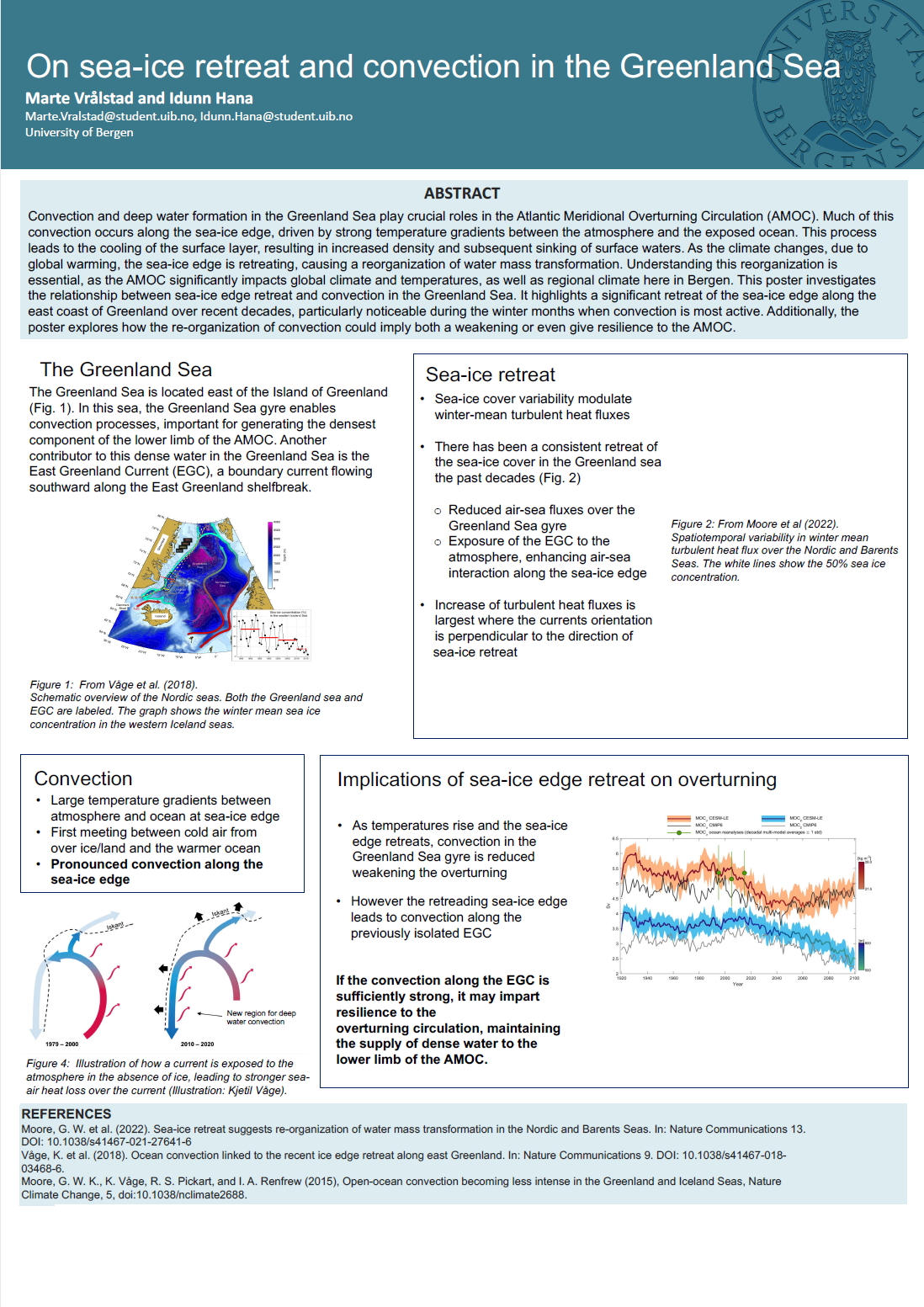
On ice retreat and convection in the Greenland sea

Abstract

Convection and deep-water formation in the Greenland Sea play crucial roles in the Atlantic Meridional Overturning Circulation (AMOC). Much of this convection occurs along the sea-ice edge, driven by strong temperature gradients between the atmosphere and the exposed ocean. This process leads to cooling of the surface layer, resulting in increased density and subsequent sinking of surface waters. As the climate changes, due to global warming, the sea-ice edge is retreating, causing a re-organization of water mass transformation. Understanding this re-organization is essential, as the AMOC significantly impacts global climate and temperatures, as well as regional climate here in Bergen. This poster investigates the relationship between sea-ice edge retreat and convection in the Greenland Sea. It highlights a significant retreat of the sea-ice edge along the east coast of Greenland over recent decades, particularly noticeable during the winter months when convection is most active. Additionally, the poster explores how the re-organization of convection could imply both a weakening or even give resilience to the AMOC. By examining these dynamics, the poster shed light on relationships between the sea-ice edge, convection, and broader implications for global climate.

Poster number:

338_2

Authors:

Marte Vrålstad
& Idunn Hana

GEOF338 - Spring 2024

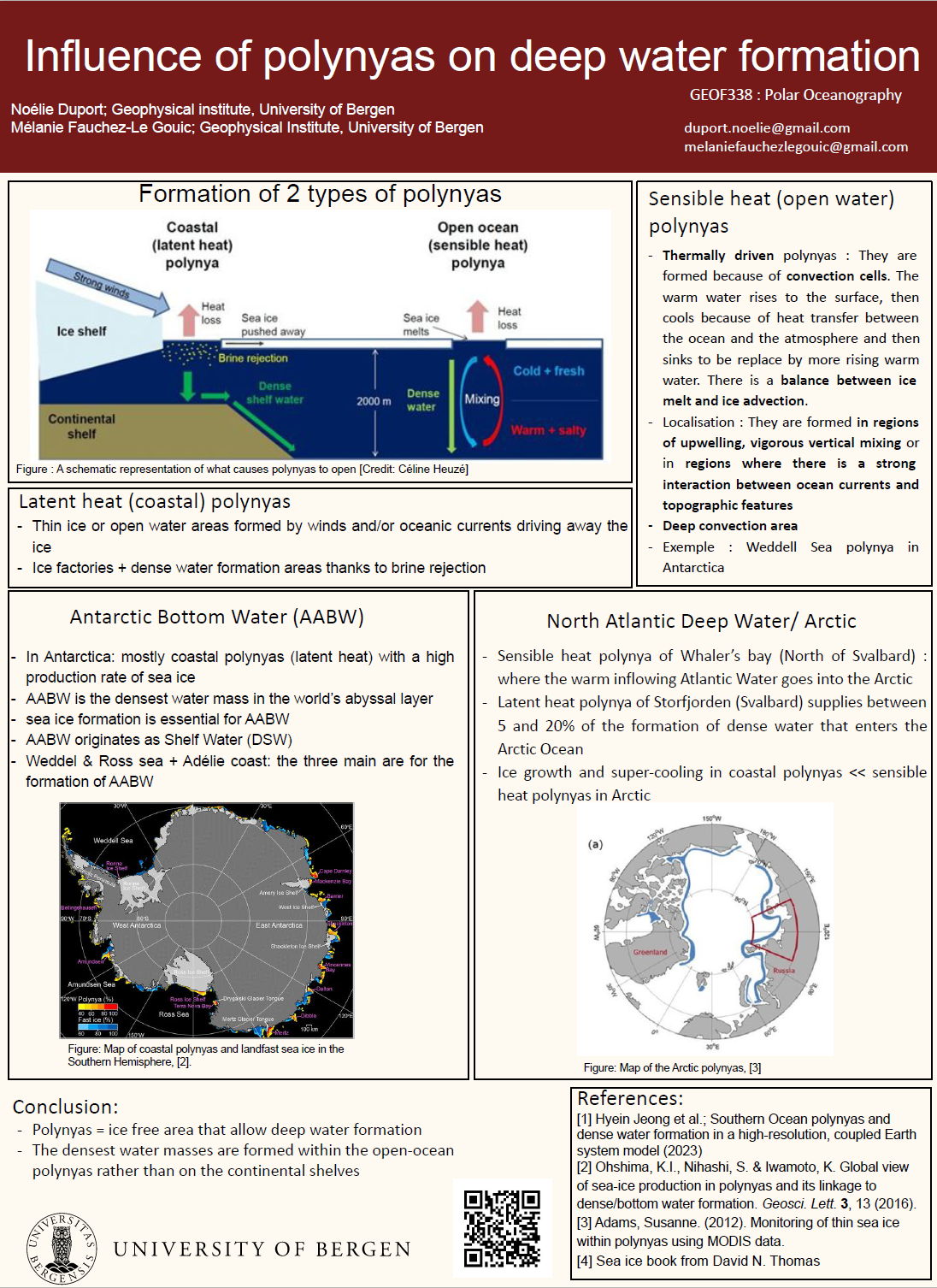
Influence of polynyas on deep water formation

Abstract

Polynyas are primarily open water sea ice free areas surrounded by sea ice, formed by either strong winds or oceanic currents that drives away the sea ice. There are two types of polynyas: coastal polynyas (very thin ice present) and open water polynyas (no sea ice). For both types of polynyas, it is the direct contact between the atmosphere and the water that leads to the formation of deep water. Indeed, the water will cool much faster in polynyas thanks to the absence of sea ice or the presence of very thin sea ice, thus the water will be denser and even more so with the salinity released from the surrounding sea ice. The two main areas for deep water production are the North Atlantic (North Atlantic Deep Water (NADW)) and the Southern Ocean (Antarctic Bottom Water (AADW)).

Poster number:

338_1

Authors:

Melanie Fauchez-Le-Gouic
& Noelie Duport

GEOF338 - Spring 2024